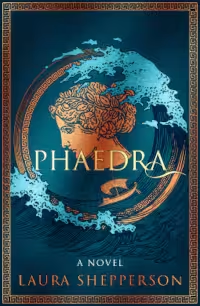
| Title: | Phaedra |
|---|---|
| Author: | Laura Shepperson |
| ISBN: | 9781639101535 |
| Year published: | 2023 |
| Year I read: | 2025 |
| Rating: | 👍👍 Cool |
Content warning: Spoilers abound. Sexual assault, suicide, and a rant about U.S. politics.
Why does tragedy exist? Because you are full of rage. Why are you full of rage? Because you are full of grief. — Anne Carson
I saw a review of Phaedra that said, “I don’t see why portraying Phaedra as a rape victim is necessary.”[1]
Because we exist. We are full of rage. We are full of grief.
And for writers, reframing a myth is a “way in” to telling other stories. You can find myth retellings unoriginal and cliché – that’s fine – but I do take issue with the certain class of “classicists” who act like Greek myth is untouchable, sacred, sacriligious to be retold.
The ancients did this themselves. Euripides wrote two versions of Hippolytus (the same myth that this book is based on) because it is thought that the overt sexuality of the first was offensive to his audience. Do you think nobody was offended by his Medea, in which he portrays a child murderer as a sympathetic protagonist, and uses her as a mouthpiece for the plight of women and immigrants?
Retelling, reframing, sharing different perspectives – that’s what writers do. It’s not as if the original myth disappears if somebody writes their own version of it. Every copy of the Iliad doesn’t magically vanish if somebody enjoys Song of Achilles. You don’t have to enjoy adaptations, but that also doesn’t necessarily make them wrong.
Another reviewer said they found it corny that the characters said “me too.”
Hello from the U.S. in 2025. There’s no “Me Too.” A rapist was elected president and now people (late to the party I might add) are outraged about his involvement in a pedophile ring run by elites. His move? To release the victims’ names, so that the victims can be blamed, shamed, discredited, threatened, while he continues his authoritarian regime.
I’m not saying this to be morbid. My point is that “progress” and things like “Me Too” don’t last under fascism. So if a writer wants to write about rape victims coming together to say “me too,” you can find it corny – that’s fine – but respect that solidarity with fellow survivors, and the feeling of being believed, is a poignant fantasy for many people.
I’ve tried writing a review without acknowledging these “Feminist? I automatically must shit on it!” reviews, but you know what? Call me dramatic, but from the perspective of somebody living in a country where they might start burning books, I realize that the space this book occupies in the world is as important, maybe more important, than the book itself.
As for the book itself? Does the political context, alone, make it... enjoyable? Of course not. So let’s get into the actual writing:
In this retelling, Shepperson recasts Phaedra much younger than how she’s traditionally depicted – a teenager. Hippolytus is still a misogynist, but has trouble remaining as chaste as he proclaims to be. This time, when Phaedra accuses Hippolytus of rape, it is not a lie.
Phaedra is one of those books with multiple narrators. Honestly, I’m a little tired of this trope, but it worked decently enough here. The characters are diverse in age and class, and I like that. Funnily, their narration didn’t sound very distinct from one another, but honestly, I prefer this over an author trying too hard to make their characters sound distinct. The prose is passable. It’s not breathtaking or anything; it serves its purpose and propels the story along.
This is a story about surviving rape through a feminist lens. Even so, Shepperson doesn’t shy away from portraying misogyny and victim blaming from fellow women, even the title character herself. This is not a simple “us” vs. “them” take. Even Hippolytus, before revealing his true nature, is shown with small glimmers of charm and good moments.
The pacing in the middle of the story felt a little off. Since I already knew what Hippolytus was going to do (the back cover is not exactly subtle), I felt uncomfortable about the back and forth between Phaedra and Hippolytus, given that it felt slightly romantic. However, while uncomfortable, I also praise Shepperson for this. This sort of dynamic feels realistic for teen sexual violence, and acquaintance rape is a reality.
That ending was wild to say the least.
I loved the chapter where Phaedra kills Hippolytus. It alluded perfectly to the ending of the Euripides play. This is the biggest moment of cathartic justice that Phaedra gives us, and it’s very tasty.
Honestly, I was surprised by Trypho’s feelings for Phaedra and his desire to save her. I feel it would have been more interesting to have Medea give Phaedra and her baby a mercy kill (hopefully with Phaedra’s consent), alluding to her earlier murder of her children. I felt like that was a missed opportunity.[2] Medea honestly felt misplaced throughout Phaedra, and that ending would have made her inclusion make sense. A story where Medea, traditionally a feminist icon, ends up disempowered, is not a very hopeful story.
But it’s clear that Shepperson was going for tragedy, and this story is definitely tragic. Women turning their back on one another, and men’s sympathy coming too little too late, are parts of that tragedy.
I don’t usually enjoy books that are so dramatically bleak. Maybe the setting is what helped. It also begs the question, why would you want to read a story that is dissatisfying – “why does tragedy exist?” Paraphrasing Aristotle and Carson, tragedy is meant to help release your pent up feelings of rage and grief (aka, catharsis), and I think I felt that here.
All in all, I was highly entertained by Phaedra – though I admit I don’t know who I’d recommend it to, so make of that what you will. It was definitely fun(?) to read immediately after reading Euripides’ Hippolytus!
It’s worth noting this is the first modern Greek retelling I’ve read, and I look forward to reading more, alongside the classics themselves. Look at me getting into fanfic in my 20s!
👍👍
“I don’t see why portraying Hercules as a sub is necessary.” “I don’t see why Pasiphae fucking a bull is necessary.” “I don’t see why Kronos sucking on a nymph’s titty after he transformed into a horse is necessary.” What even is “necessary”? I don’t find the gods raping humans “necessary,” and yet I acknowledge that there are many myths where this is depicted. What, specifically, makes rape victims not “necessary”? This is fantasy. All of this is frivolous and unnecessary. ↩︎
In Jean Racine’s version she kills herself using a potion that Medea made!! ↩︎
